Newsroom
New Book Offers Lifeline for Parents of Struggling Readers
For Immediate Release
Publicity Contact: Wendy Brickman
(831) 633-4444 or Brickman@Brickmanmarketing.com
New Book Offers Lifeline for Parents of Struggling Readers
May 2026. Madison, WI — Kim Feller, founder and instructor of Feller School in Madison—the only school in Wisconsin dedicated specifically to students with dyslexia and related learning differences—has launched a new book designed to help parents navigate one of the most stressful challenges they face: a child who is not learning to read.
Feller School has also recently expanded to serve students in K–6th grade and is offering specialized literacy and math summer camps, along with teacher training programs.
At a time when many families are worried—and often overwhelmed—Feller's new book, Your Brain Loves Patterns: A Parent's Guide to Dyslexia and the Science of Reading (now available on Amazon), provides clear, practical answers. Written in an engaging, accessible style, it helps parents nationwide recognize early warning signs, ask informed questions, and advocate for instruction that aligns with how their child's brain learns.
"Nearly one in five parents know when something isn't working, but they're often told to wait or try harder," said Feller. "For families navigating the uncertainty of a struggling reader, the book helps them to understand what's really going on and gives them the tools to take action. The message is clear: when instruction matches how a child's brain learns, children don't just improve, they transform."
With the right type of explicit, systematic reading instruction, results like those achieved at Feller School are possible nationwide. Last year, all of the students who entered performing below the 20th percentile nationally—improved their oral reading fluency.
Forty-seven percent doubled their reading speed, and 32% tripled it, as total words read correctly per minute rose from 954 to 1,769—an 85% gain in a single year. One example is Allie, a 3rd grader who began the year reading just 4 words per minute at 40% accuracy and reached 40 words per minute at 91% accuracy by June. Beyond academics, schools can also see meaningful gains in student confidence and well-being, with parents reporting outcomes such as, "Her confidence went from a 3 to an 8 or 9," and "We don't have to go to therapy anymore."
Low literacy is closely associated with significant societal challenges, including higher rates of involvement in the justice system, persistent unemployment, and substantial economic costs, underscoring the far-reaching impact of inadequate reading skills on both individuals and the nation.
Drawing on more than 35 years of experience, Feller explains why common reading approaches that rely on memorization and guessing often fail, and why structured, pattern-based instruction is more effective. Research shows that up to 97% of English words follow predictable patterns, yet many students are never taught these rules directly. More information is found here: https:// www.fellerschool.org/understanding-dyslexia
Many well-known figures—from Walt Disney and Winston Churchill to Steven Spielberg, Richard Branson, Thomas Edison, Magic Johnson, Muhammad Ali, and Jennifer Aniston and many others—have had dyslexia. Although they achieved great success, with optimal instruction aligned to how their brains learn, many might have reached their potential sooner and with much less frustration. Dyslexia is not a barrier to success! It reflects a different way of processing the world—and with the right tools and instruction, Feller School students not only catch up, but often excel beyond expectations.
About Kim Feller, author and founder of the Feller School
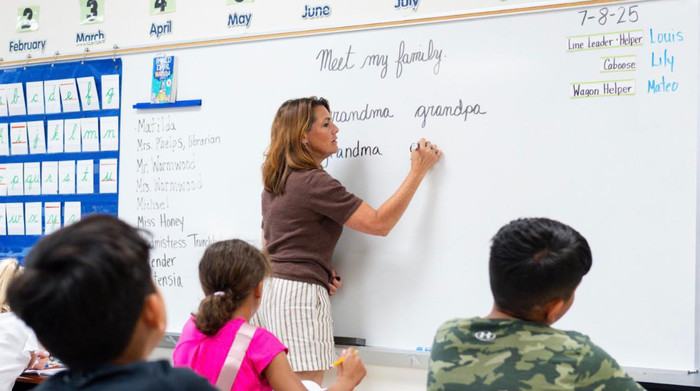
Kim Feller has spent more than 35 years working with children who struggle to read and helping their families understand why. After teaching in public and private schools across multiple states, she concluded that struggling readers were not failing—the system was failing them.
She founded Feller School in 2021 with five students; today, it is an expanding independent 501(c)(3) nonprofit serving K-6 students with small classes and individualized, science-based instruction. The program integrates speech and occupational therapy into the school day and emphasizes a whole-child approach that reduces stress for families while rebuilding student confidence. Results have been significant, with many students making measurable gains within a year and some returning to traditional classrooms at grade level with renewed confidence.
For more information, visit www.fellerschool.org or call (608) 271-7551 ext. 133.